Ian Coupland CSC MSyI
Behavioural Analysis, Awareness & Human Factors

Understanding people. Strengthening Awareness. Improving Assurance

What Are You Missing?
Sometimes, the most important part of communication isn't spoken.
Could Your Organisation Benefit?
Whether you're conducting interviews, managing difficult conversations, introducing workplace changes or engaging with customers, greater behavioural awareness can help you ask better questions, recognise potential misunderstandings and make more informed decisions.
About Me

My professional background combines security, workplace investigations and corporate risk assessment with specialist training in body language and micro-expression recognition.I have conducted security risk assessments at major corporate sites in the City of London, investigating incidents, engaging with personnel and reviewing operational procedures.I bring this practical experience together with behavioural observation and micro-expression recognition to help organisations develop greater awareness of non-verbal communication, strengthen professional judgement and support more informed decision-making.
Professional Certifications
My specialist qualifications from the Centre for Body Language complement my professional experience in security, investigations and operational risk assessment.Certified Body Language Master
Certified Micro Expressions PractitionerThese qualifications support my approach to behavioural observation, communication awareness and balanced, evidence-led interpretation.


My Areas of Focus
Recognising how assumptions, behavioural patterns and communication can influence decisions and create operational vulnerabilities.
Strengthening workplace relationships through effective questioning, communication awareness and a better understanding of human behaviour.
Assessing whether procedures are understood, competence is demonstrated and operational controls work in practice.
Applying security experience, structured questioning and behavioural observation to investigate concerns and support evidence-based decisions.
Careful Observation. Balanced Interpretation. Practical Insight
Combining investigative experience with specialist behavioural training to provide clear, impartial observations that
support better-informed decisions.
How Can I Help
Recognise Any of These Challenges?

Difficult Conversations
Have you ever finished an important conversation feeling that something wasn't quite understood, or that a concern remained unspoken?Learning to recognise changes in communication and behaviour can help you identify when to ask another question, clarify a response or explore an issue more carefully.

Interviews & Investigations
Have you ever reviewed an interview or investigation and felt there were questions that hadn't quite been answered?Sometimes, changes in behaviour, facial expressions or communication can highlight moments worth exploring further.Through structured behavioural analysis, I can help identify those moments, consider possible explanations and suggest areas for further enquiry — providing an additional perspective to support your investigation, not a judgement about whether someone is telling the truth.

Customer Engagement
Have you ever come away from a customer meeting thinking everything went well, only to discover later that the customer had concerns you hadn't recognised?Sometimes, what people say and how they communicate don't appear to tell quite the same story. That doesn't necessarily mean anything is wrong, but it may be an opportunity to explore further.By developing greater awareness of verbal and non-verbal communication, your team can become better equipped to recognise uncertainty, ask more effective questions and understand customer concerns before they become bigger problems.

Meetings & Workplace Change
Have you ever introduced a change at work, explained it clearly in a meeting and believed everyone understood — only to discover later that people were uncertain, concerned or reluctant to engage?People don't always express their concerns openly. Changes in communication, participation or behaviour may suggest that something needs further clarification, although there can be many reasons for those changes.By developing greater behavioural awareness, managers can become better equipped to recognise when further discussion may be helpful, encourage people to raise concerns and check that important messages have genuinely been understood.

Risk & Operational Assurance
Have you ever reviewed an incident or workplace concern where all the correct procedures appeared to be in place, yet something still went wrong?Policies, processes and compliance checks are essential, but they don't always reveal how people interpret instructions, communicate concerns or make decisions in everyday situations.By examining the human factors behind workplace behaviour, I can help organisations identify areas that may warrant further enquiry, recognise potential communication gaps and develop greater behavioural awareness.The aim isn't to replace existing assurance processes, but to provide an additional perspective that supports better-informed questions, stronger communication and more effective risk management.
Recognise a Situation in Your Organisation?
Whether you're looking to develop your team's communication skills or explore a particular situation through structured behavioural analysis, we can discuss what would be most useful.
An initial conversation can help establish whether training, analysis or another approach would be appropriate.
Analysis
Behavioural Analysis
Behavioural analysis offers a fresh perspective on recorded interviews, conversations and interactions.By examining facial expressions, body language and non-verbal communication in context, I provide independent, structured observations that may highlight moments worthy of further consideration.The aim is to support informed enquiry and understanding — not to determine whether someone is being truthful or to draw conclusions from isolated gestures.
featured service
Recorded Behavioural Analysis
Looking Beyond the Obvious

Sometimes, reviewing a recorded interview or interaction raises more questions than answers. You may notice something unusual but be unsure whether it warrants further attention.I provide independent behavioural analysis of existing recordings, examining facial expressions, body language and communication in context.You'll receive a structured written report identifying significant observations, their possible interpretations and moments worth exploring further, with references to relevant points in the recording.
How it Works
My recorded behavioural analysis service follows a straightforward, confidential process.01 Initial Enquiry
We begin with a conversation about your situation, what you'd like to understand and whether behavioural analysis would be appropriate.02 Agreement & Data Protection
We'll agree on the scope of the work, the intended use of the report, confidentiality arrangements and the necessary permissions and data protection requirements before any recording is shared.03 Secure Recording Transfer
Once an appropriate secure transfer method has been agreed, you provide the existing recording and any relevant background information needed to understand the context.04 Behavioural Analysis
I review the recording, examining facial expressions, body language and communication in context. I identify observations that may warrant further enquiry, while considering alternative explanations and the limitations of behavioural interpretation.05 Written Report
Yu'll receive a structured report highlighting relevant observations, references to moments in the recording, possible interpretations and suggested areas for follow-up.The report provides an additional perspective to support informed enquiry, rather than a determination of someone's intentions or truthfulness.
Behavioural analysis isn't about finding definite answers.
It's about recognising what behaviour might suggest, exploring other explanations and asking better questions.
Example Reports
Behavioural Risk & Analysis
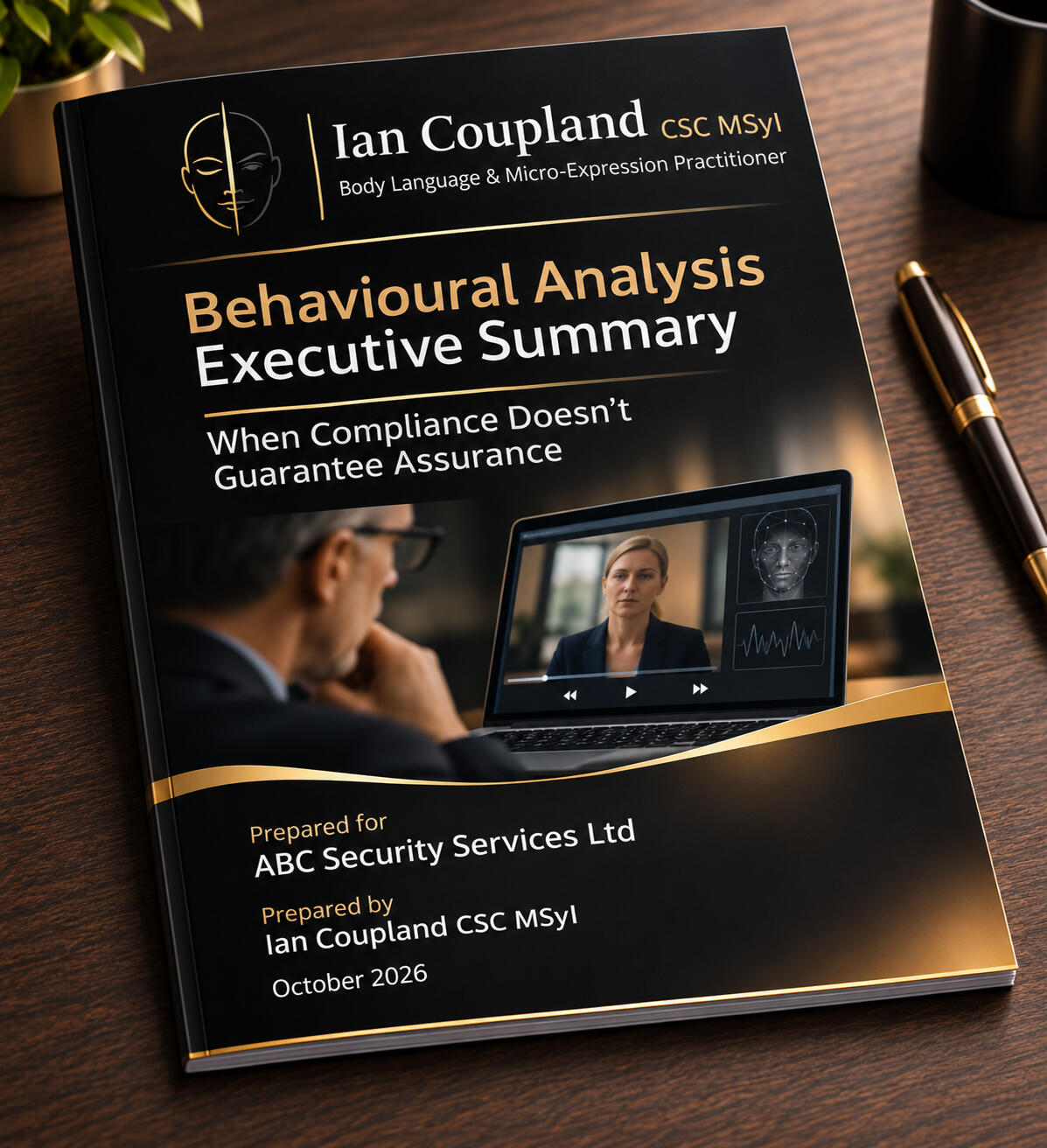
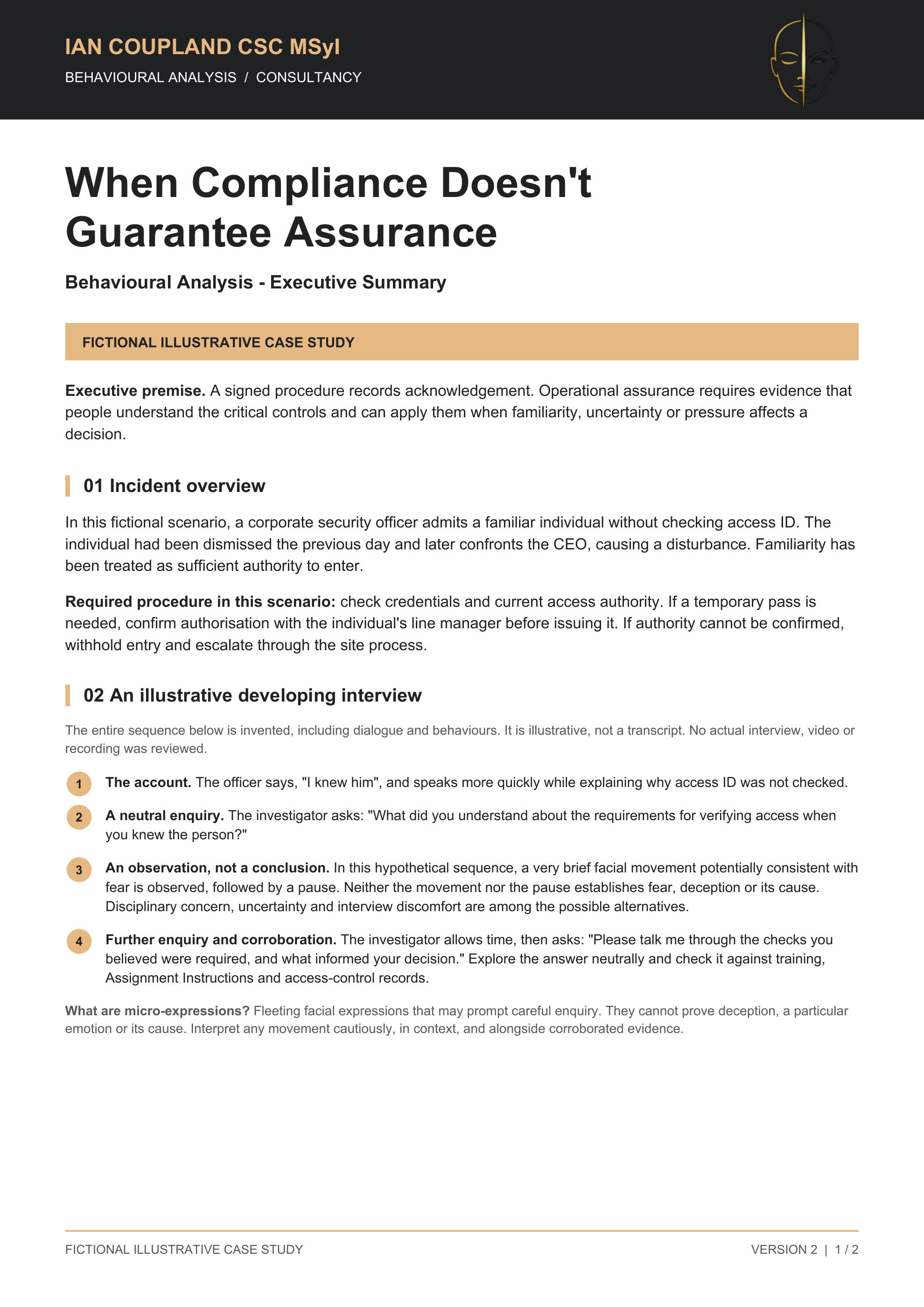
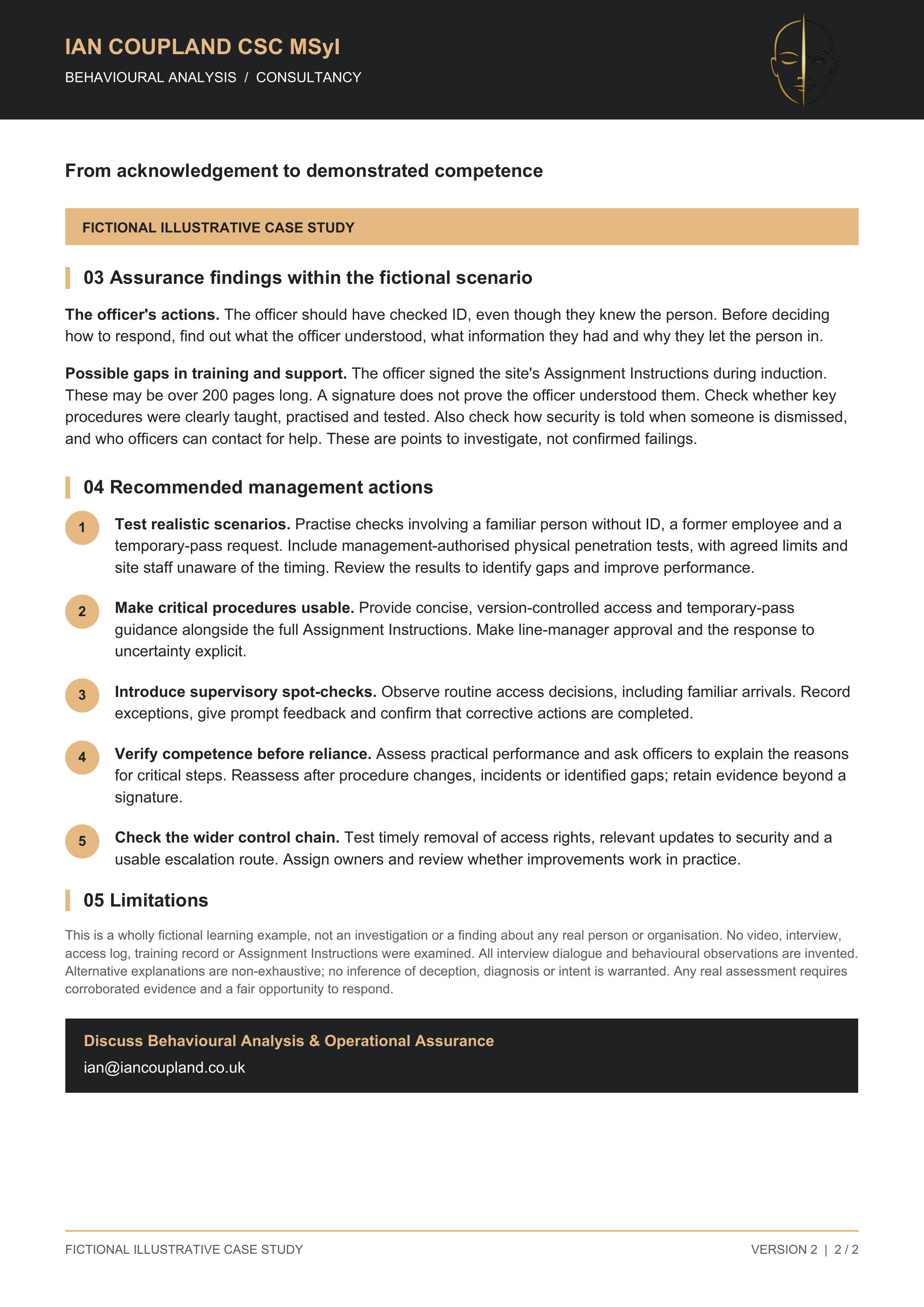
When Compliance Doesn't Guarantee Assurance
The Client's ChallengeA security officer allows a familiar individual into a corporate building without checking their access authority. The individual had been dismissed the previous day, raising questions about how established security procedures were understood and applied.What This Example DemonstratesThis fictional case study explores how behavioural observations, careful questioning and operational assurance can work together to identify areas requiring further investigation.Using an entirely invented interview scenario, it illustrates how changes in communication might prompt additional questions, while also examining whether critical procedures have been understood, practised and consistently applied.The example concludes with practical management recommendations aimed at strengthening assurance beyond simply confirming that procedures have been acknowledged.
View Sample Executive Summary
A more comprehensive behavioural analysis report can also be commissioned, providing detailed observations, time-stamped references and supporting commentary.
Behavioural Assurance
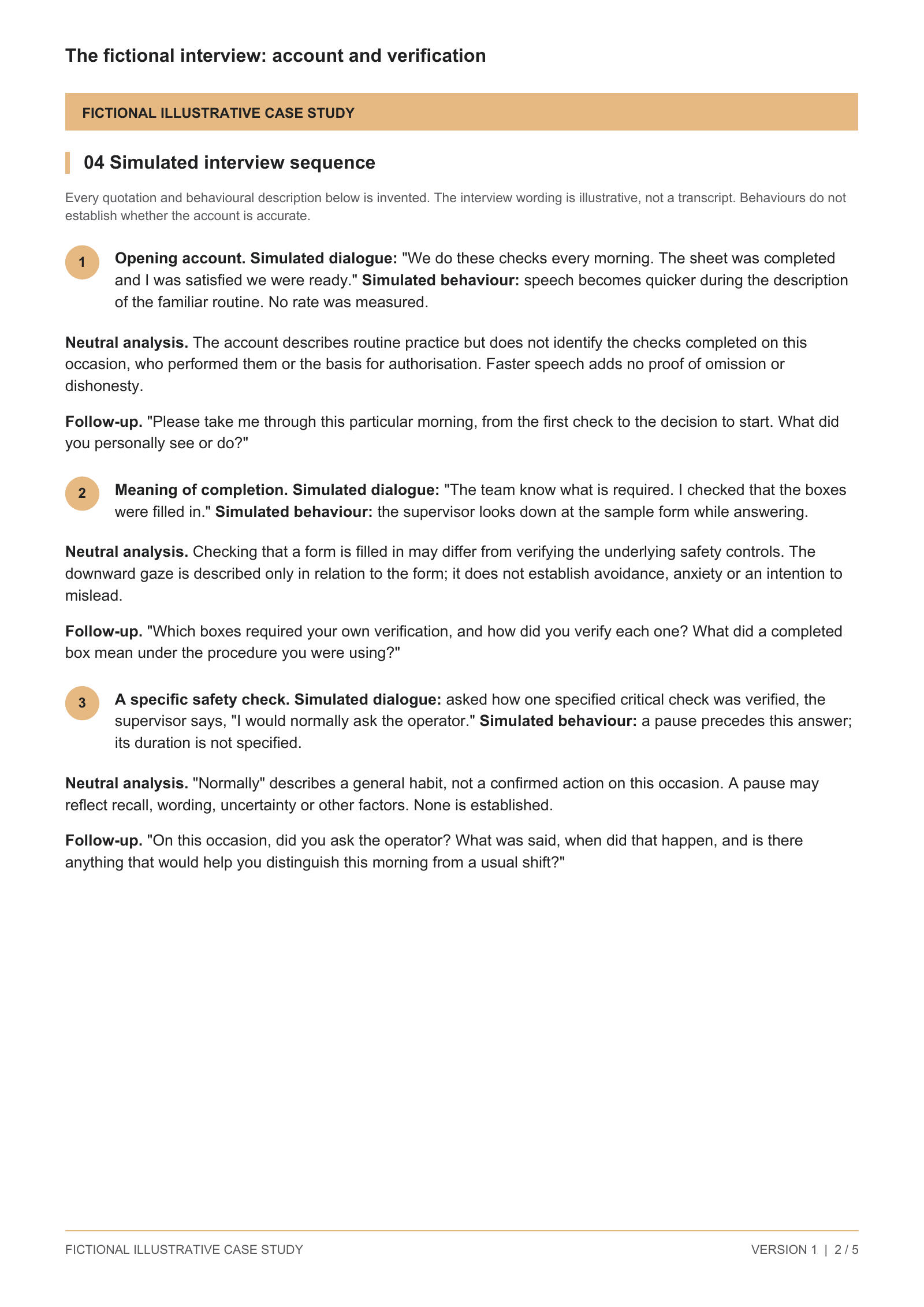
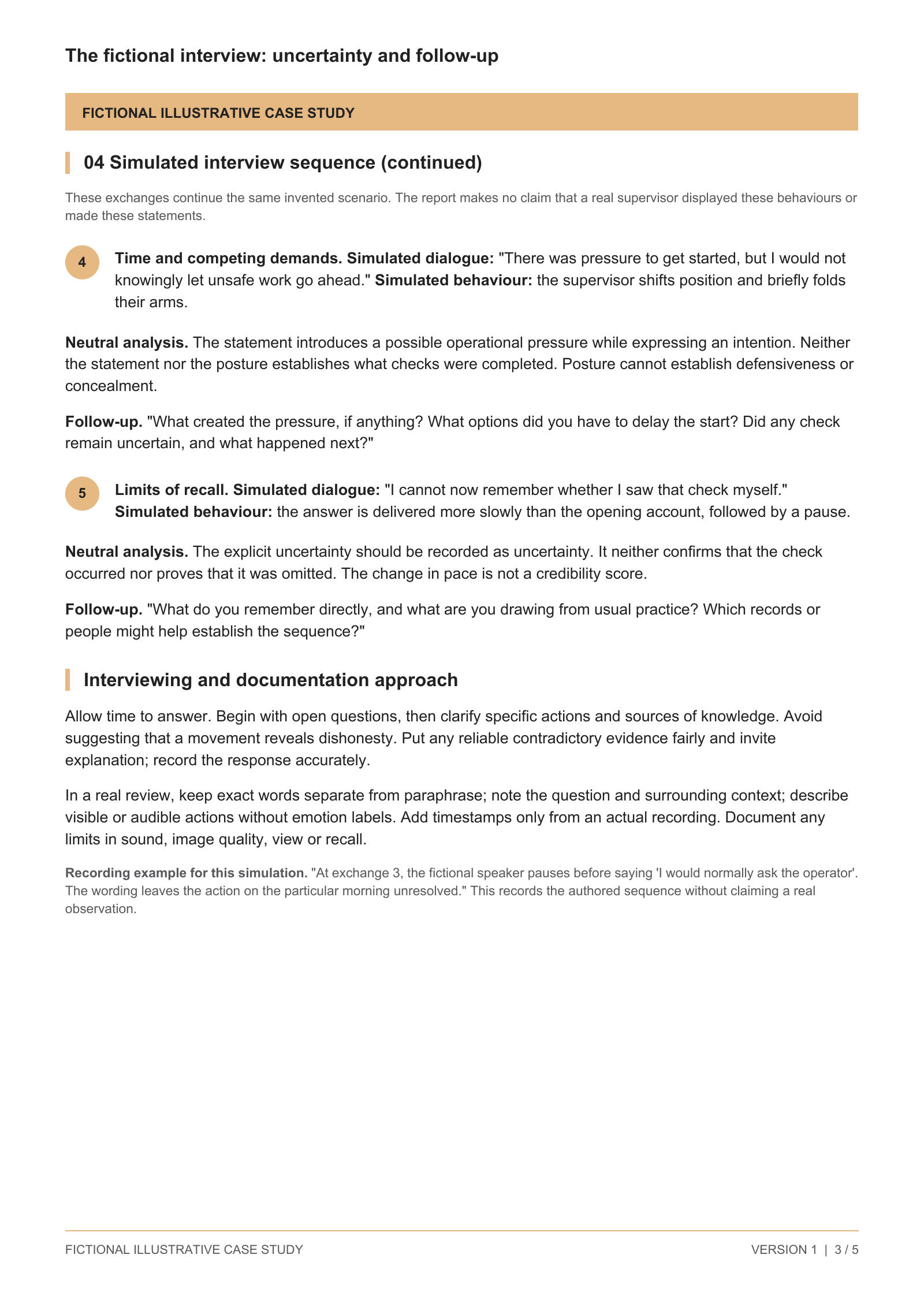
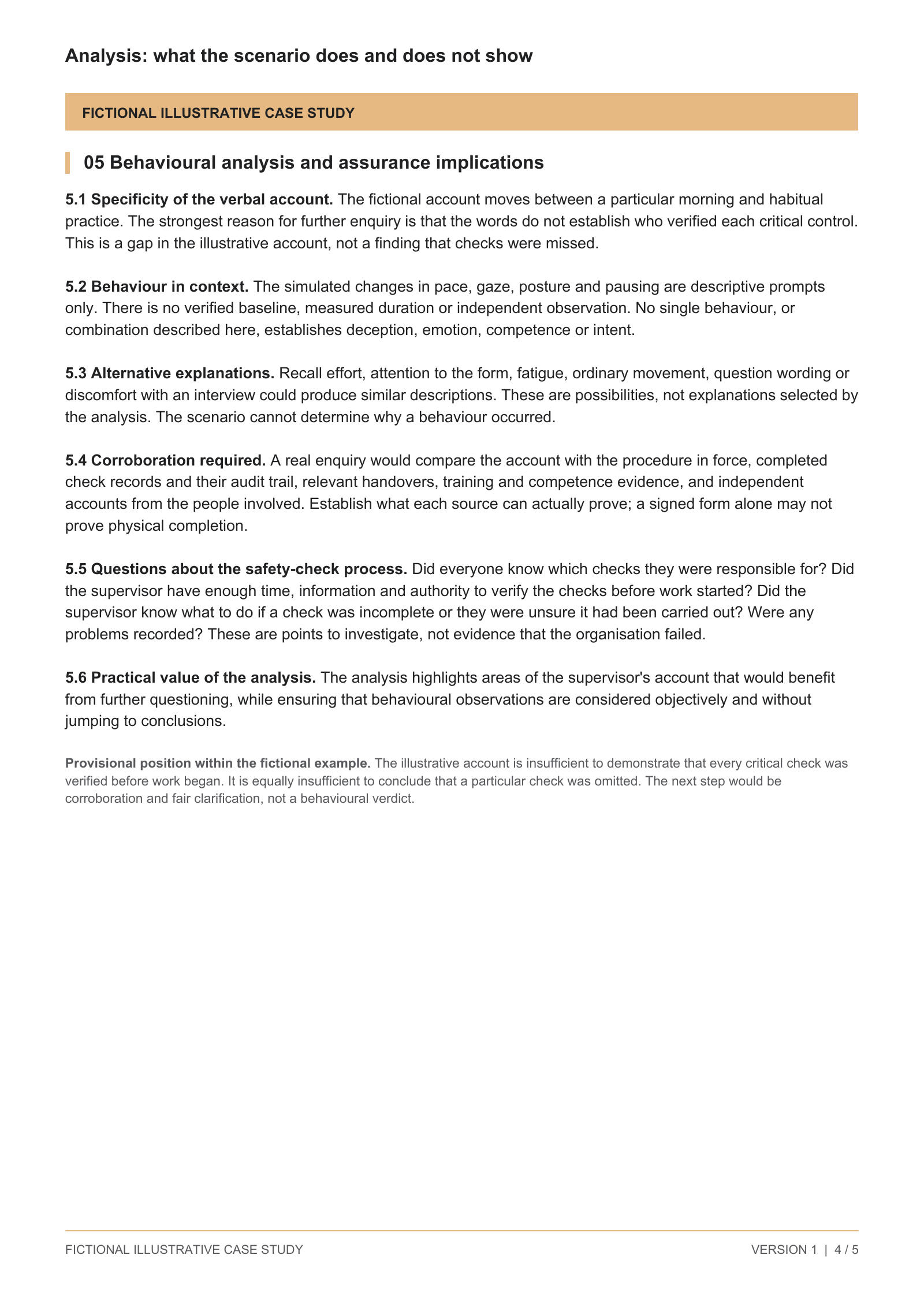
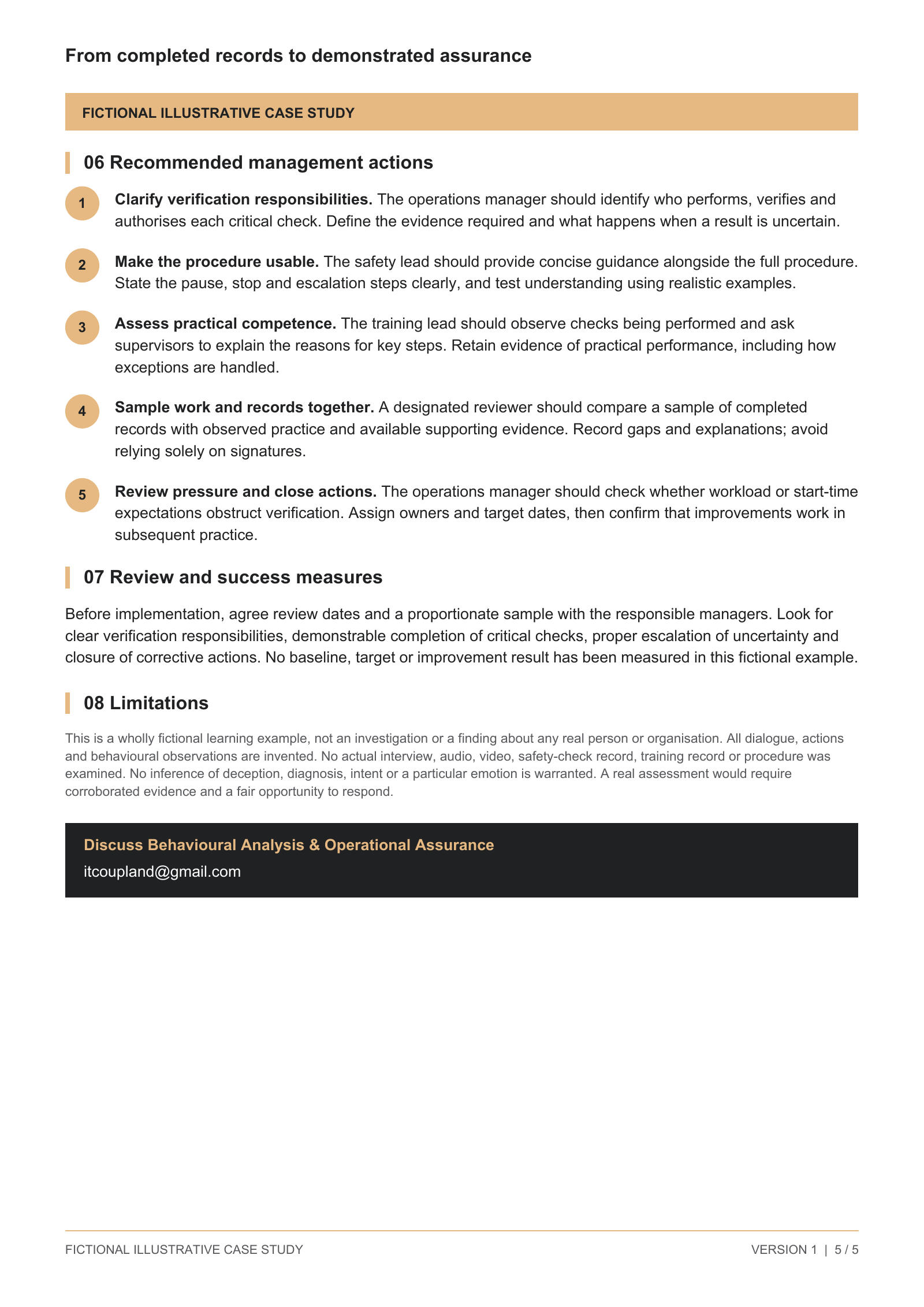
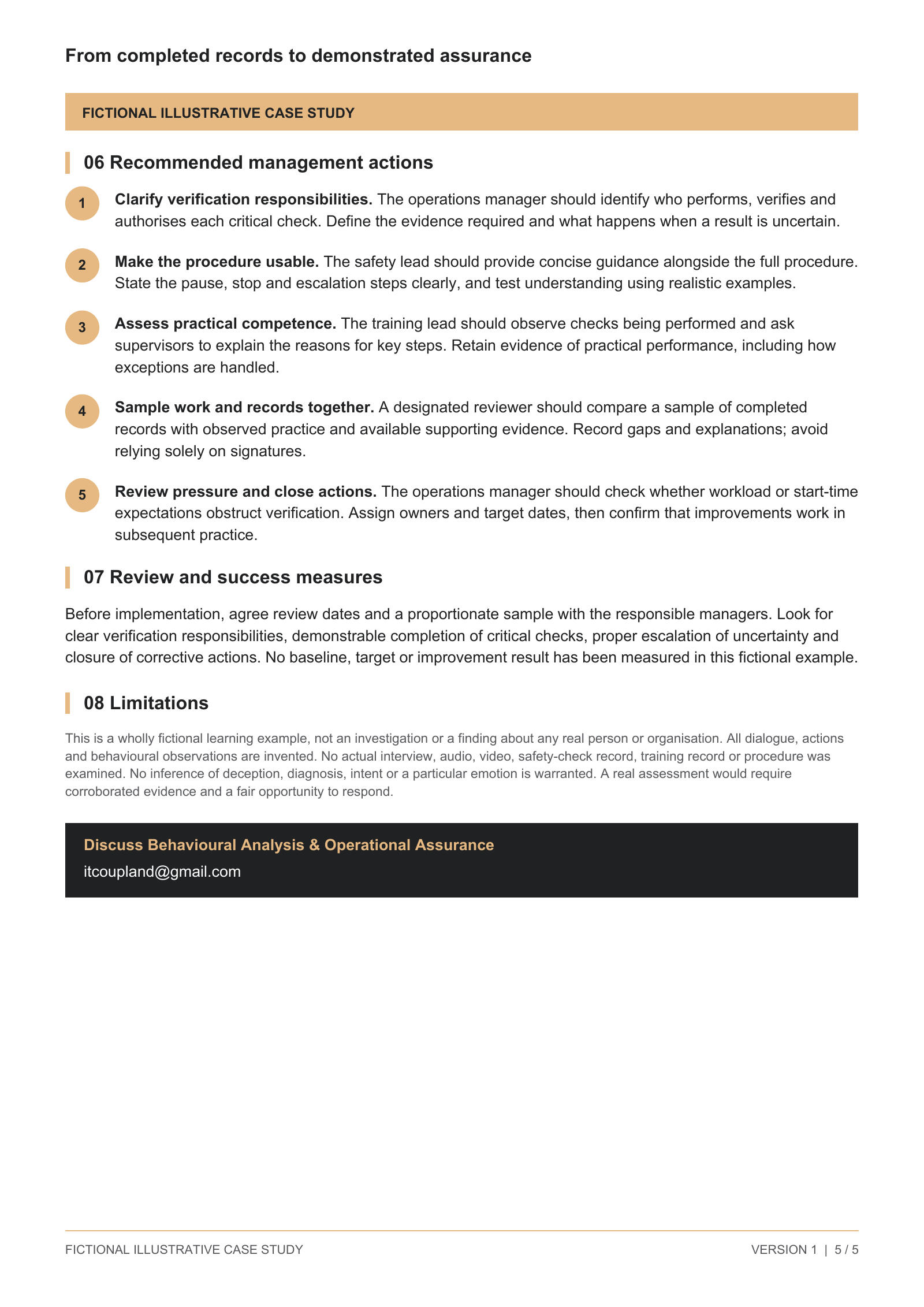
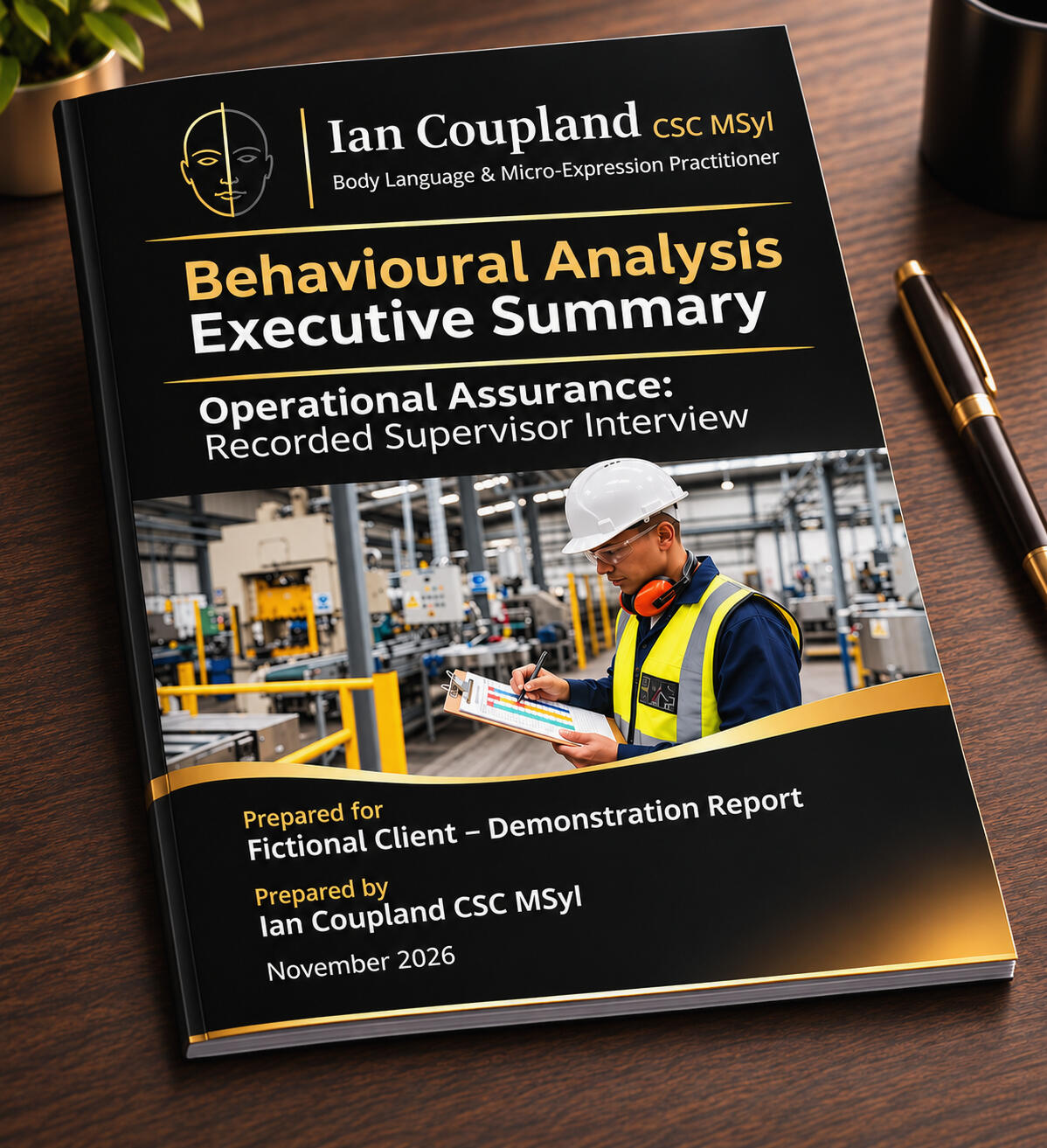
Recorded Supervisor Interview
View Sample Executive Summary
A more comprehensive behavioural analysis report can also be commissioned, providing detailed observations, time-stamped references and supporting commentary..
The Client's ChallengeAn internal audit identifies missing records for routine workplace safety checks across three shifts. The supervisor responsible maintains that the checks were completed, but cannot explain why the supporting documentation is unavailable.What This Example DemonstratesThis fictional case study illustrates how independent behavioural analysis of a recorded interview can help identify areas of an account that would benefit from further questioning.Using an entirely simulated interview, the analysis examines changes in verbal and non-verbal communication, including pauses, speech patterns, gestures and responses to specific questions.The observations are considered alongside alternative explanations, without treating individual behaviours as evidence of dishonesty.The report concludes with suggested follow-up questions to help management clarify the supervisor's recollections, responsibilities and the circumstances surrounding the missing records.
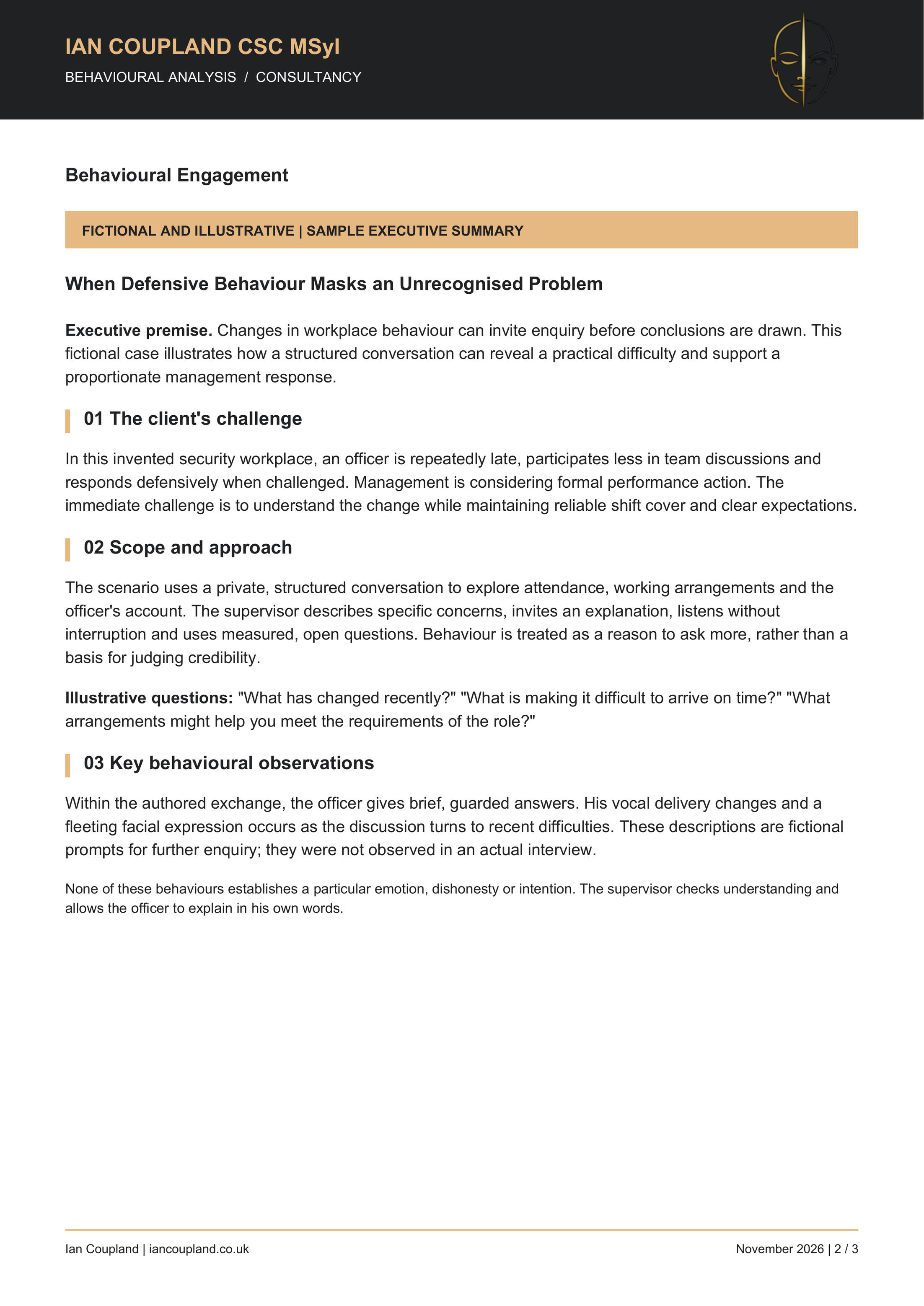
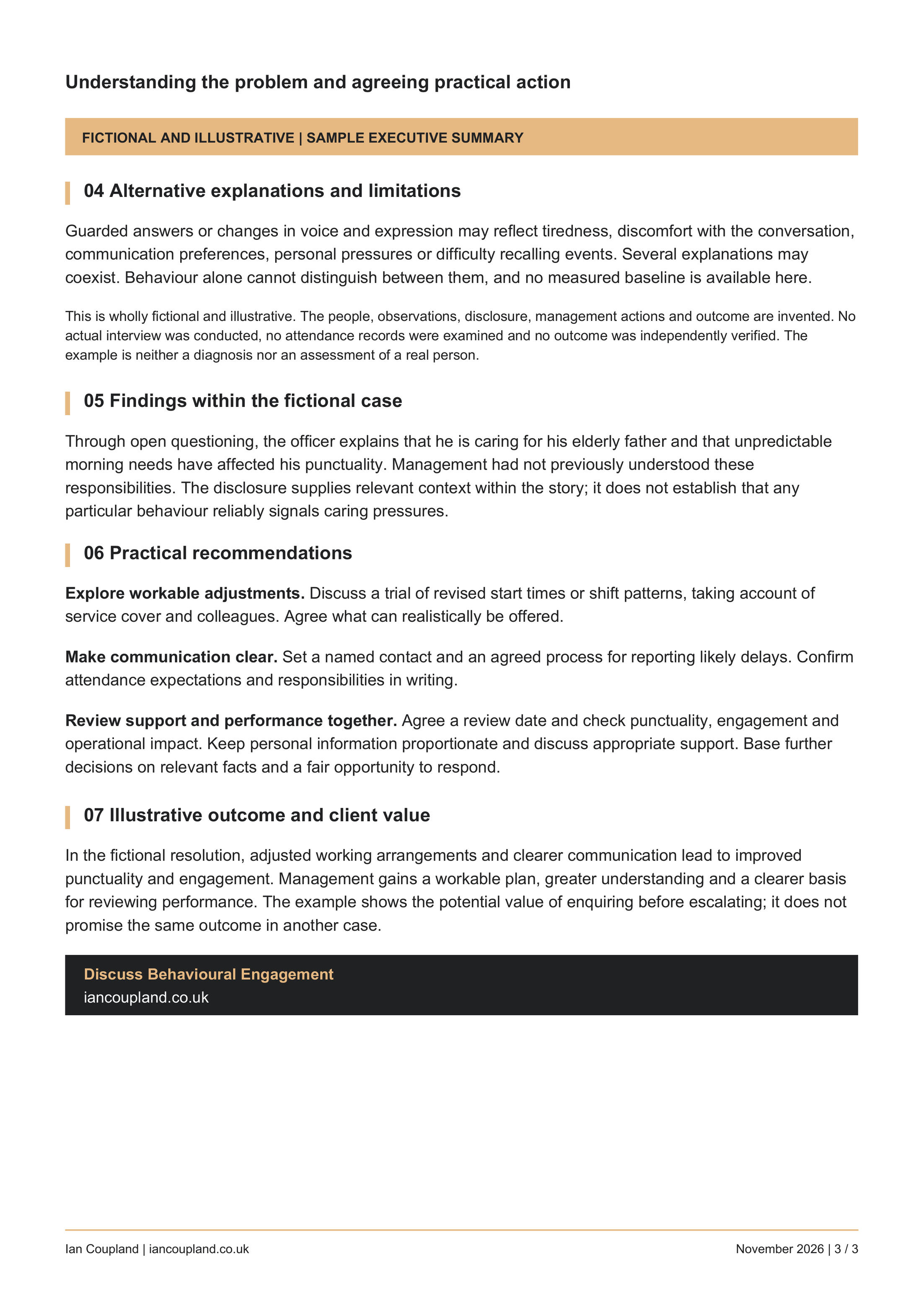
Behavioural Engagement
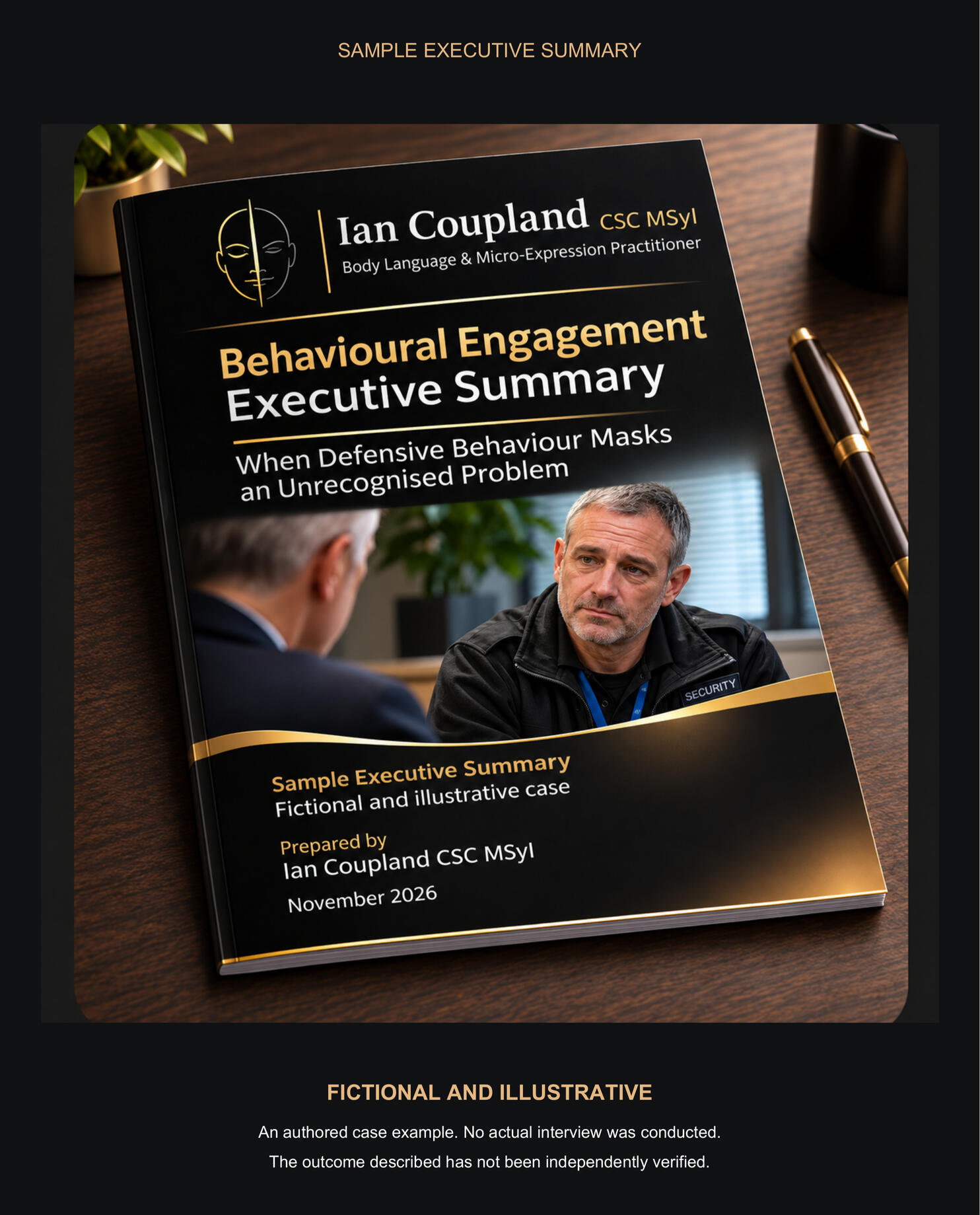
When Defensive Behaviour Masks an Unrecognised Problem
The Client's ChallengeA security officer has become the subject of repeated supervisory concerns involving lateness, reduced engagement and defensive responses to questions about his performance.Management believes the officer is unwilling to cooperate and is considering formal performance action.The client wants to understand whether the situation reflects an attitude or performance problem, or whether other factors may be contributing to the officer's behaviour.What This Example DemonstratesThis fictional case study illustrates how behavioural observation and constructive questioning can help managers look beyond an employee's defensive responses.During a structured conversation, guarded behaviour and a fleeting facial expression prompt further enquiry, without assuming what these behaviours mean.The officer subsequently discloses caring responsibilities affecting his punctuality and engagement.By exploring the circumstances rather than making premature judgements, management identifies practical adjustments that improve communication, attendance and employee engagement.
View Sample Executive Summary
A more comprehensive behavioural analysis report can also be commissioned, providing detailed observations, time-stamped references and supporting commentary.
Risk & Investigations
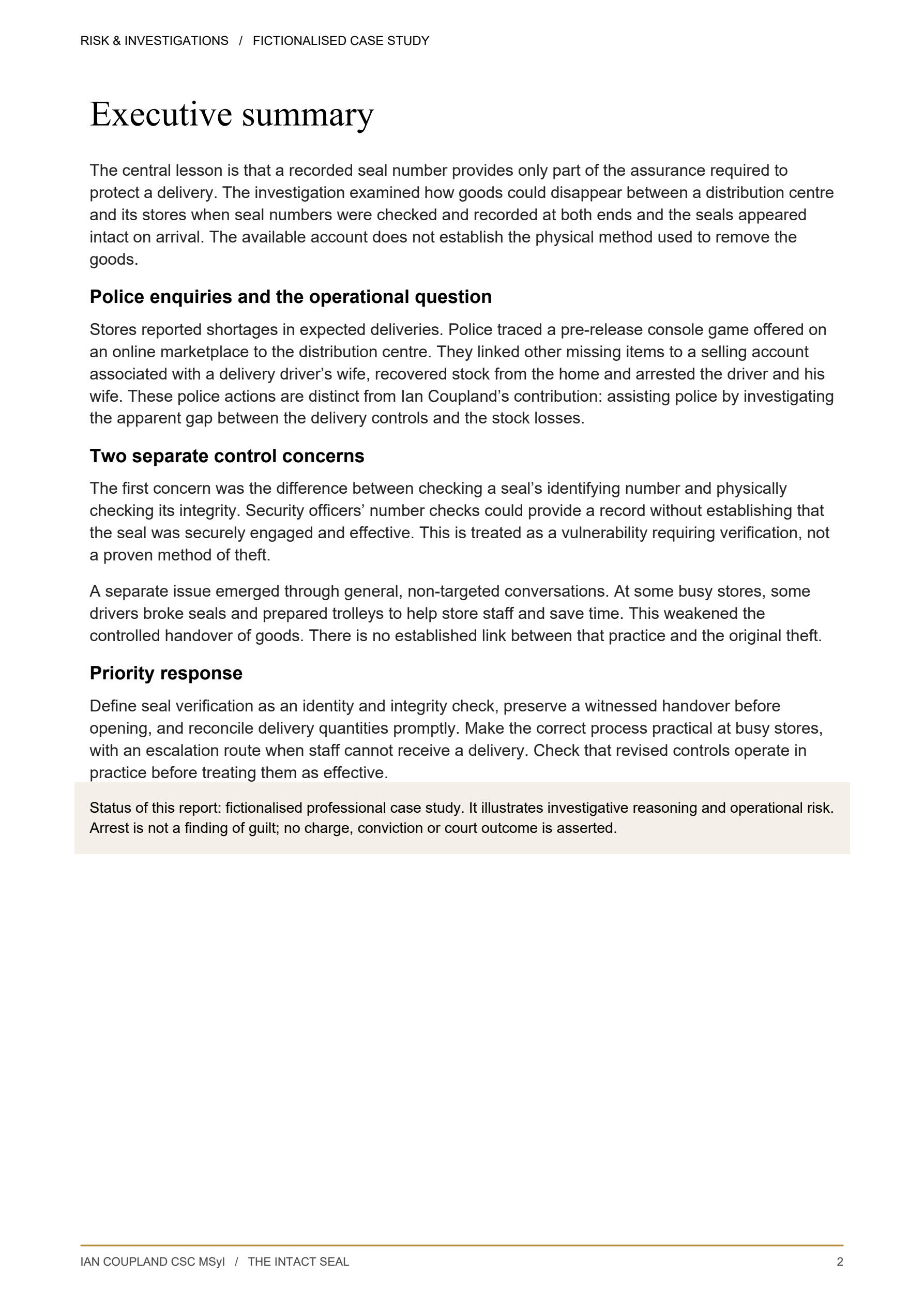
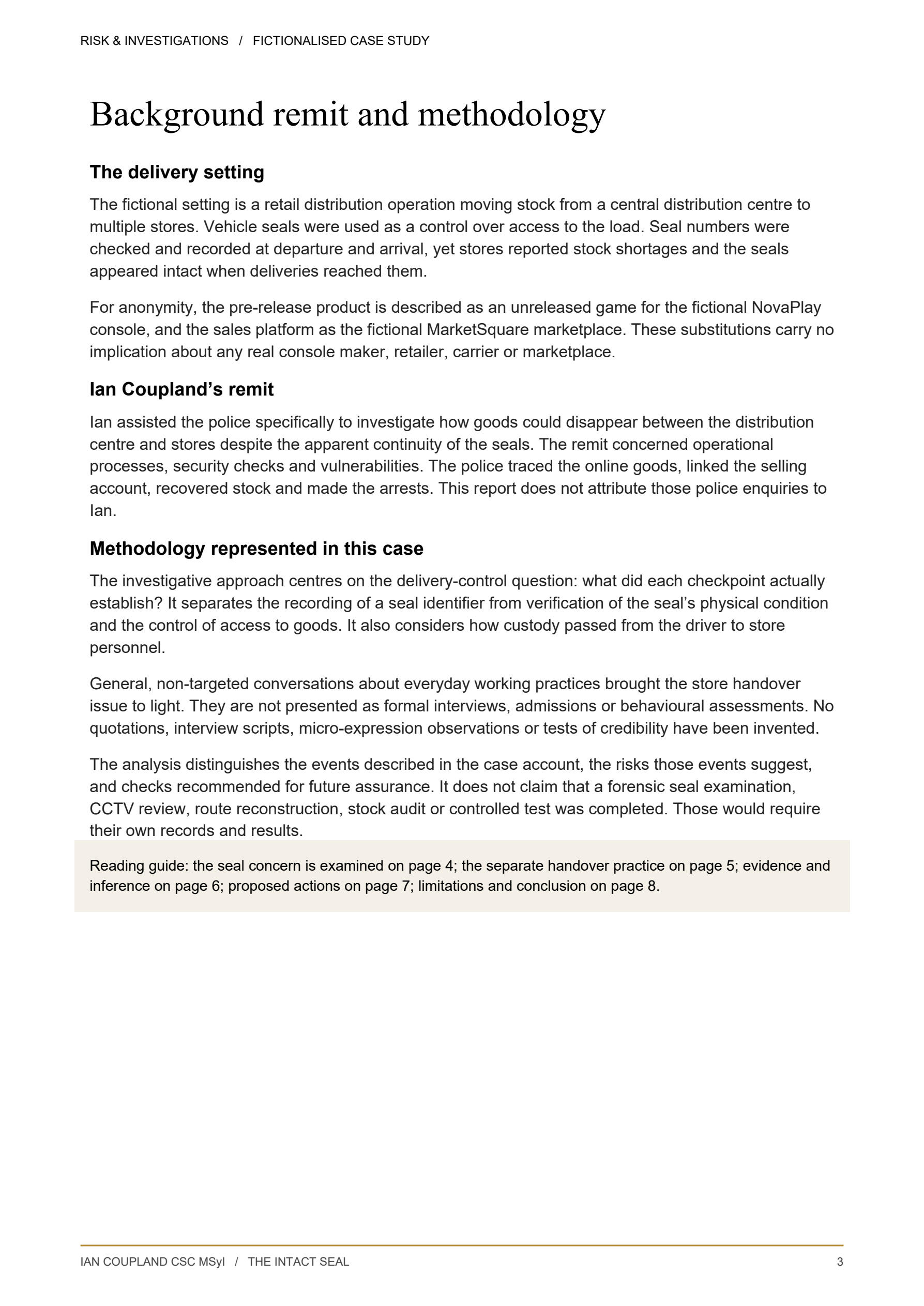
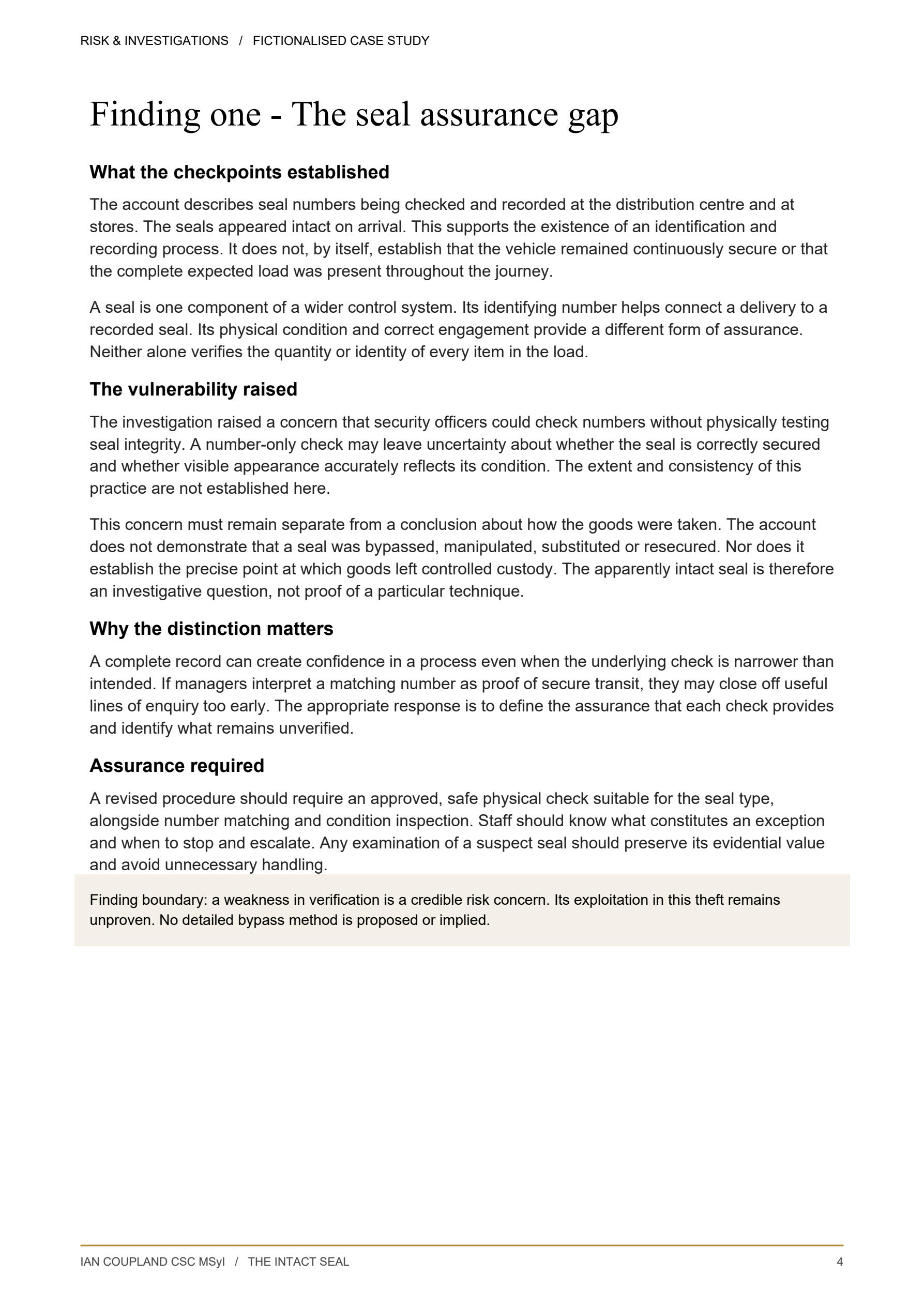
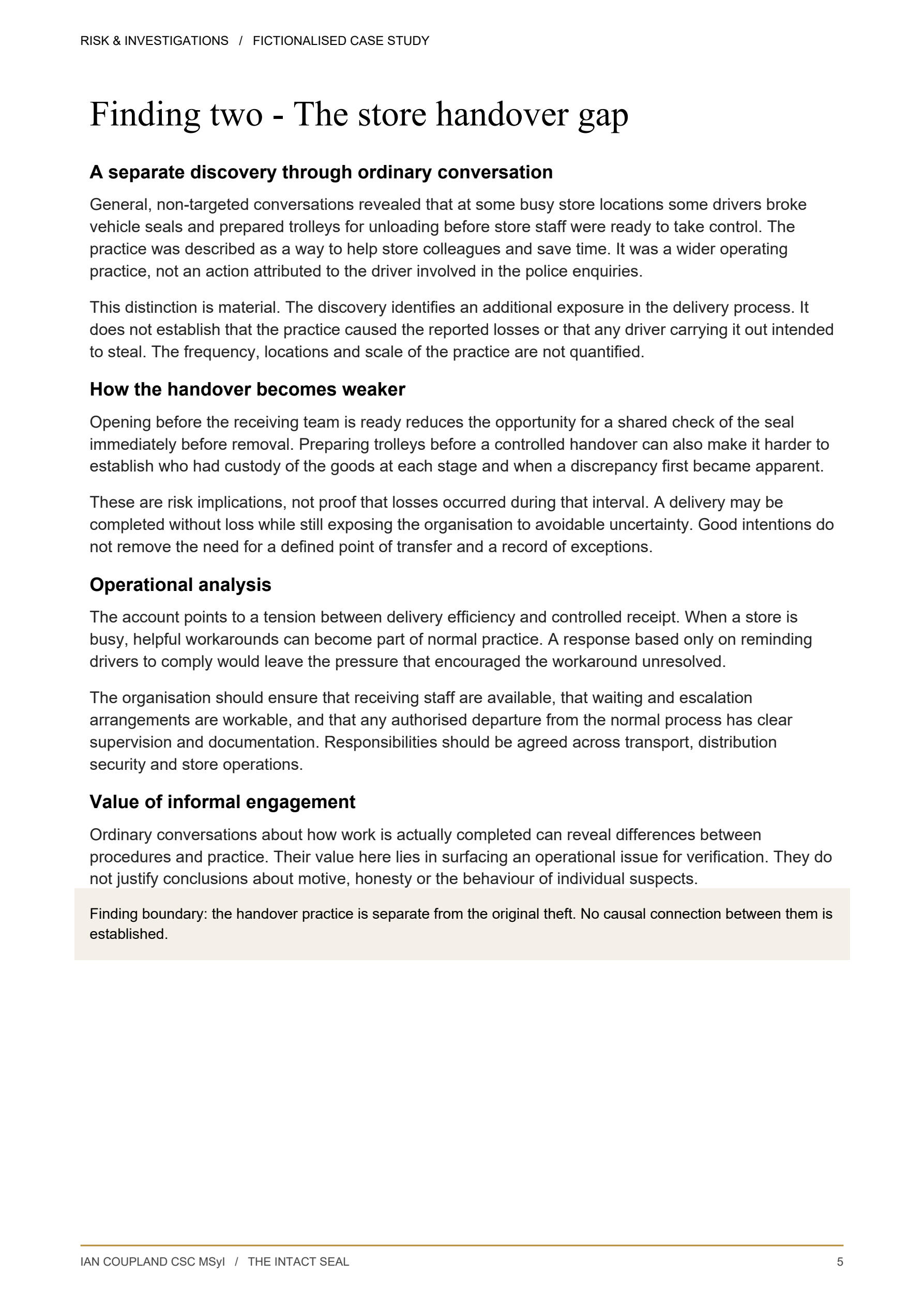
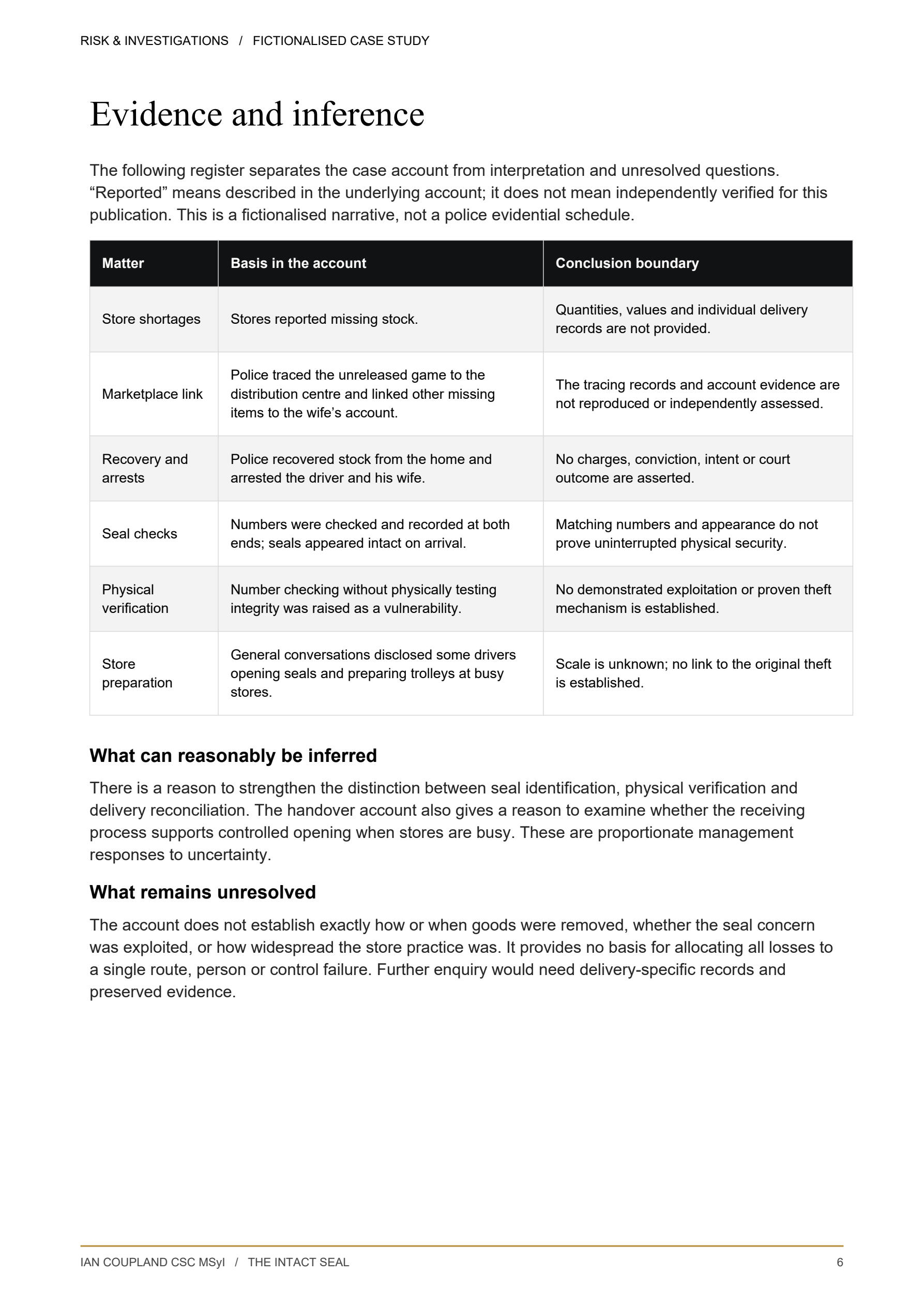
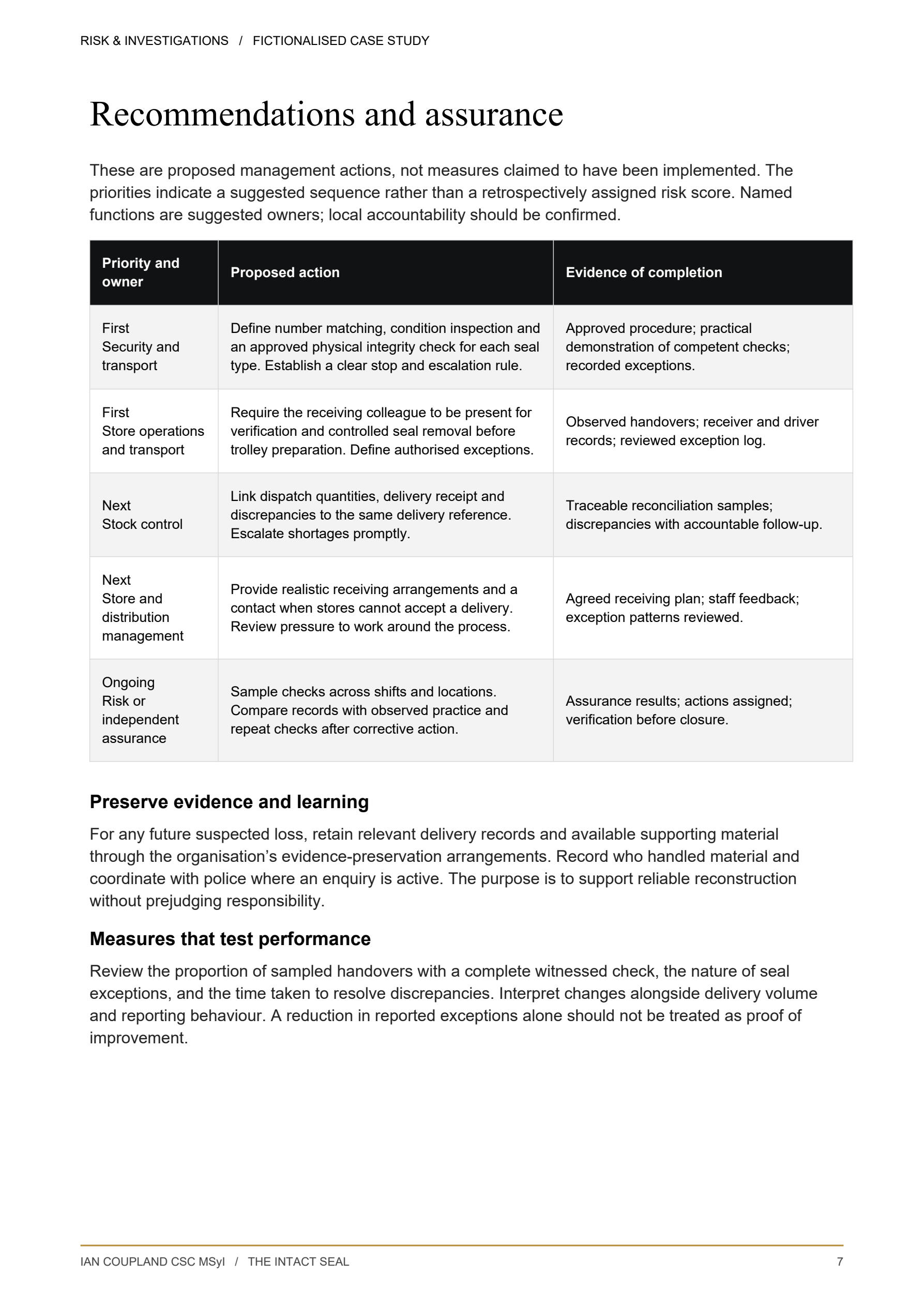
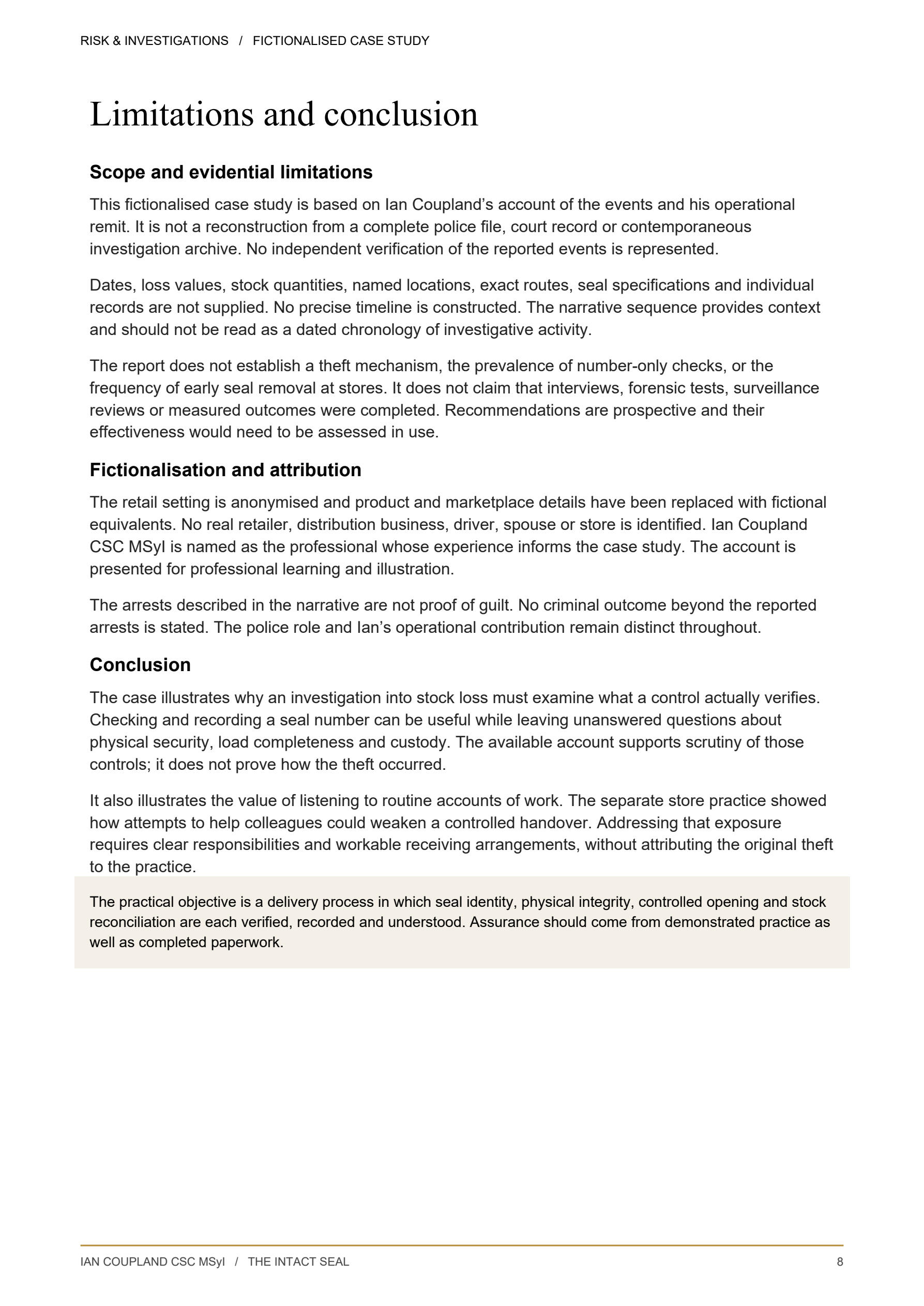
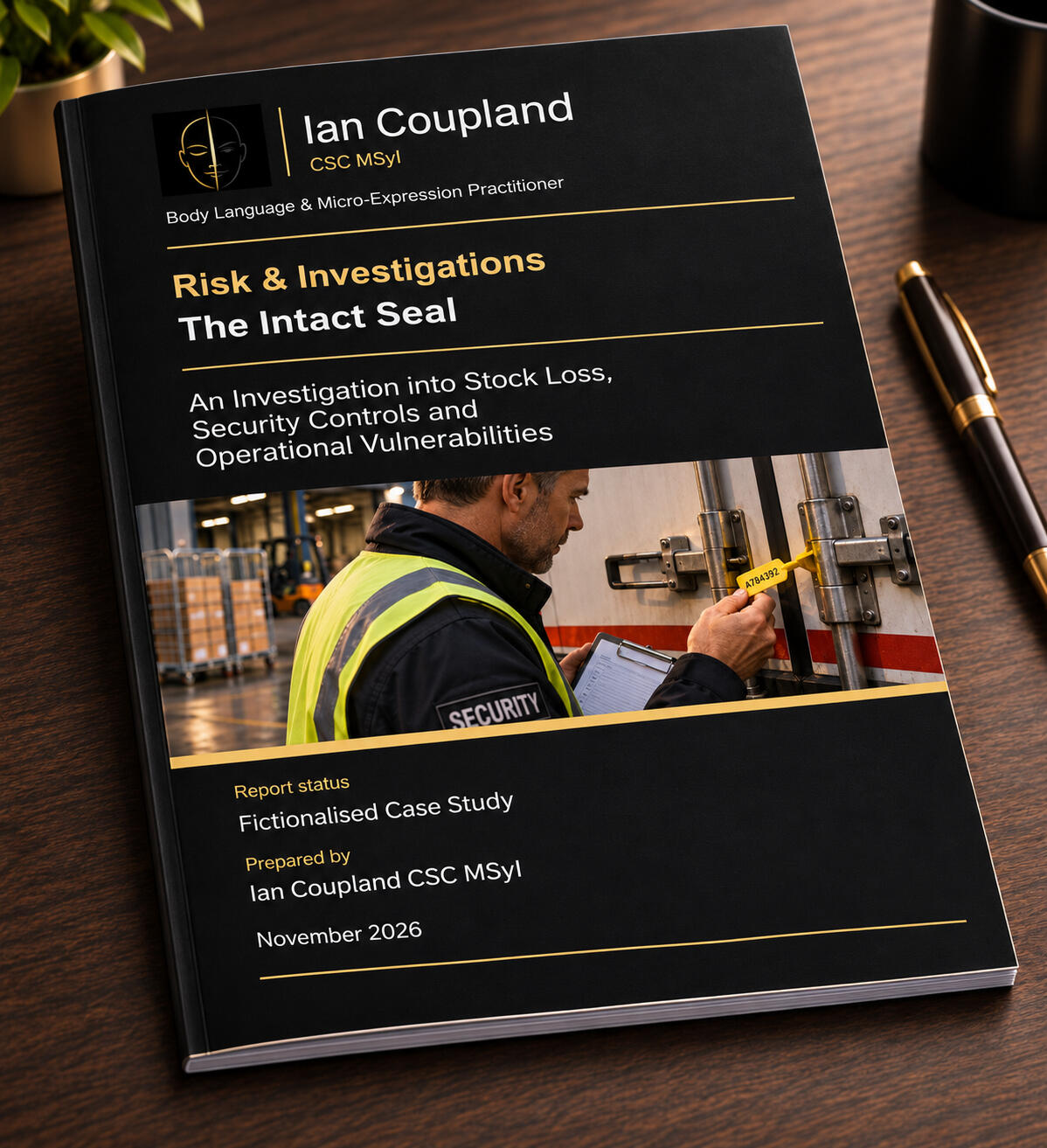
The Intact Seal
View Sample Investigation Report
An in-depth fictionalised investigation demonstrating how evidence-led enquiry, operational assessment and behavioural awareness can identify hidden security vulnerabilities and support practical improvements.
The Client's ChallengeA major distribution centre faces an investigation following repeated reports of stock shortages at retail stores. Police enquiries link missing merchandise to online sales and identify a delivery driver suspected of involvement.However, a significant question remains: how could stock disappear when vehicle security seals were checked and recorded before departure and again upon arrival at the stores?The client needs to establish whether existing security procedures are genuinely effective or whether previously unidentified vulnerabilities are allowing stock losses to occur.What This Example DemonstratesThis fictionalised case study illustrates how investigative enquiry, operational knowledge and structured questioning can uncover security weaknesses that routine compliance checks may overlook.The investigation examines the effectiveness of vehicle security checks, including the distinction between recording seal numbers and physically verifying seal integrity.During wider enquiries, informal conversations reveal a separate vulnerability: at some busy stores, drivers routinely break security seals and prepare stock for unloading before the formal handover.Although generally intended to help store colleagues, this practice creates opportunities for stock losses and weakens accountability.The report demonstrates how effective investigation can identify not only potential security failures but also the everyday working practices that expose organisations to additional risk.
Training & Development
Understanding people starts with noticing more.
Have you ever left an important conversation wondering whether you missed something? Perhaps a colleague seemed uncomfortable, a customer appeared uncertain, or an interview raised questions that weren't fully explored.Developing greater awareness of facial expressions, body language and communication can help people recognise when further clarification may be useful, ask more effective questions and respond with greater confidence.I'm developing practical training programmes for individuals, supervisors, managers and teams who want to strengthen their observation, communication and questioning skills through guided observation, realistic examples and interactive exercises.The aim isn't to make assumptions about what someone is thinking or feeling, but to become more observant, communicate more effectively and recognise opportunities for better conversations.

Micro-Expression Recognition Training
Learning to notice the expressions we often miss..Have you ever noticed a fleeting facial expression during a conversation and wondered whether it was worth exploring further?This training is being developed to help participants recognise brief facial expressions, improve their observational skills and become more aware of emotional communication.Through practical exercises and guided examples, participants will learn to notice subtle changes in expression and consider when a thoughtful follow-up question might be useful — without assuming that a facial expression reveals exactly what someone is feeling or thinking.
Body Language Training — Including BLINK
This training is being developed to help participants become more aware of body language, non-verbal communication and the ways these can influence workplace interactions.The training will also introduce BLINK, a conversation technique developed by the Centre for Body Language. Rather than relying solely on questions, BLINK uses carefully considered statements or suppositions while observing the other person's immediate facial expressions and body language. These reactions can provide opportunities to explore a conversation further, without assuming they reveal what someone is thinking.
Interested in Future Training Opportunities?
Would you like to develop your own behavioural awareness or explore training opportunities for your team?I'm developing practical programmes covering body language, micro-expression recognition and effective communication.Register your interest in the subjects most relevant to you, and I'll contact you when suitable training opportunities become available.Registration is free, with no obligation to book or purchase.
Contact
Let's Start a Conversation
Have a situation you'd like to explore, or want to develop your team's communication and behavioural awareness?You don't need to know which service would be most appropriate. Simply get in touch with a brief outline of what you're looking to achieve.I'll review your enquiry and, where appropriate, arrange an initial conversation to discuss how I may be able to help.[email protected]07395 586535All enquiries are treated confidentially. Please do not send recordings or sensitive information until suitable arrangements have been agreed.
Privacy Notice
Body language and micro-expressions can provide useful insights into observable behaviour and possible emotional responses. However, they cannot, on their own, reliably establish whether someone is being truthful, determine guilt or innocence, or reveal what a person is thinking.My work focuses on interpreting behavioural observations within their wider context, recognising the limitations of what those observations can establish.I do not offer lie-detection services, make determinations of guilt or innocence, or provide expert-witness testimony.
This notice explains how I handle personal information in connection with my professional services.
Planned arrangements are described as planned; they are not confirmation that a service or safeguard is
already in place.1 Who I am and how to contact me
I am Ian Coupland, a UK sole trader providing behavioural analysis, awareness and human factors services,
mainly to business clients and occasionally to private clients. For privacy enquiries, rights requests or
complaints, contact [email protected].2 What this notice covers
This notice explains how personal information is used when you enquire about, commission or take part in my
services, or appear in material supplied for analysis. It covers contact and administration records, recordings
and working material, and reports. Personal information may relate to clients, business contacts, interview
participants, employees, witnesses and other people mentioned in supplied material.3 Who controls the information
I am a controller where I decide why and how personal information is used for my own business purposes,
such as answering enquiries, managing client relationships, invoicing and handling legal claims.
For supplied interview recordings and related material, the client organisation may be the controller and I may
act as its processor, using the information only on its documented instructions under an appropriate
processing agreement. The role depends on the actual purposes and decisions, not merely the label in a
contract. A client's instruction does not automatically make all my processing processor activity.
Before an assignment, the roles must be assessed and documented. Any independent controller use,
including proposed retention for my own legal claims, needs its own justification, lawful basis and
transparency. This notice does not replace the client controller's privacy information or the processing
agreement. Private client work also requires a role assessment; a private commission does not remove data
protection obligations.4 Information collected and it's sources
Information may include names, business roles and contact details; enquiry, appointment and contractual
correspondence; billing and payment records; and material relevant to the agreed assignment. Supplied
material may include audio or video recordings, transcripts, interview context, case documents, images,
observations, analysis notes and final reports.
I receive information directly from you, from the commissioning client and from people or documents included
in client supplied material. Where required, I will explain the source of information obtained indirectly, including
whether it is publicly accessible. Clients should supply only information that is necessary, accurate and
lawfully disclosed for the agreed work.
Recordings or case material may reveal health, ethnicity, beliefs or other special category information, or
information about alleged offences or convictions. These require additional legal conditions and safeguards.
An ordinary image or voice recording is not automatically biometric special category data; processing for
unique identification requires a separate assessment.5 Purposes and lawful bases
Where I act as controller, the following bases apply only where their legal requirements are met and the
activity is necessary:
- Enquiries and business contact administration: legitimate interests in responding to requests and running the
business, after considering the individual's interests and rights.
- Steps requested by a private client before a contract, and delivery of that individual's contract:
contractual necessity. A contract with a company does not itself provide this basis for processing its
employees' or interviewees' information.
- Business client relationship management and necessary service administration: legitimate interests in
providing and administering the agreed professional service, subject to a recorded balancing assessment.
Analysis of sensitive case material needs a separate assignment assessment.
- Tax, accounting or other specific legal requirements: legal obligation, identifying the applicable requirement.
Necessary establishment, exercise or defence of legal claims may rely on legitimate interests, with additional
conditions where required.
- Optional uses genuinely based on an individual's valid consent: consent, with a clear choice and the ability to
withdraw it. Withdrawal does not affect the lawfulness of earlier processing.
Client permission or contractual authorisation is not, by itself, a UK GDPR lawful basis for the people in a
recording. The relevant controller must identify an Article 6 basis and, where applicable, an Article 9 condition
and/or Article 10 and Data Protection Act 2018 authority and safeguards before processing. The applicable
basis and conditions must be established for the particular assignment before processing begins.
Where I am a processor, the client controller determines the lawful basis. Business clients must confirm lawful
collection and disclosure, the relevant basis and additional conditions, and that required privacy information
has been provided or a valid exception documented. A compliant processing agreement is required where I
process personal data on their behalf. I must also meet my own processor obligations.6 Sharing and service providers
Access to substantive analysis is intended to be limited to me as sole analyst and the client's authorised
recipients. Reports are intended for the agreed recipients and purpose. Other disclosures may be necessary
to professional advisers, insurers, accountants, courts, regulators or public authorities where justified or legally
required. I do not sell personal information.
Email and other business service providers may process contact details and correspondence. The contact
email is [email protected]; the account's contractual status, relevant provider terms and transfer
arrangements need verification. Providers supporting receipt, storage or delivery of case material will be
selected and assessed before use. No secure upload-link provider has yet been selected and no deployed
upload workflow is claimed.
Where providers act as processors, suitable contracts and security checks are required. Where I act as
processor, any subprocessor requires the client controller's authorisation under the processing agreement and
the necessary contractual protections. Provider identities or meaningful categories and further details must be
available as required.7 International transfers
Cloud, email, support or AI services may involve access to personal information outside the UK. Before a
restricted transfer, the relevant parties must assess locations, access, contracts and risks and establish an
applicable UK adequacy arrangement or appropriate safeguards, such as the UK International Data Transfer
Agreement or UK Addendum, with the required transfer assessment. No provider, location or transfer
compliance is assumed here. Contact me for details of the safeguards applicable to your information and how
to obtain a copy, subject to lawful redactions.8 Intended security and handling
The intended arrangement is to hold recordings and working files locally in a dedicated folder excluded from
synchronisation on a BitLocker-encrypted laptop, with me as the sole analyst. This is a planned operating
arrangement to be checked before use, not confirmation that every technical control is already deployed.
Secure transfer of final reports is planned. A suitable method for both incoming material and outgoing reports
must be selected, tested and agreed before sensitive files are transferred. Contact me first to agree the
method; do not send sensitive recordings to the contact email without an agreed secure arrangement.9 Optional AI assisted review
There will be no routine uploading of recordings or case material to AI services. Occasional AI assisted review
may be considered only with the client's specific advance authorisation for the proposed tool, purpose and
material, and after the relevant lawful basis, confidentiality, processing terms, provider retention and training
use, security and international transfer safeguards have been assessed. Client authorisation does not replace
a lawful basis or any required individual consent or transparency.
Only the minimum necessary material would be used. I would review any output and remain responsible for
my professional work. AI would be an assistive review tool, not deception detection or a means of establishing
truthfulness. No solely automated decisions producing legal or similarly significant effects are intended.10 Retention and deletion
Recordings, transcripts, analysis notes and other working files are intended normally to be deleted within 30
days after delivery of the final report. A different period must be documented where agreed and lawfully
justified, or where retention is legally required. Client agreement alone does not justify unnecessary retention.
Where I am a processor, return or deletion follows the client controller's documented instructions and the
processing agreement, including deletion of copies unless law requires retention. Any independently justified
controller retention must be assessed separately and communicated as required.Final reports may be retained for up to six years only where necessary, justified and permitted, for example for
a documented legal claims purpose. Six years is not a default for every report. The appropriate period and
starting point must be recorded for each relevant category or assignment, with earlier deletion where the
purpose ends. Reports can contain sensitive information and should be minimised.Enquiries and routine correspondence are retained only for the time needed to resolve the matter and any
necessary follow-up. Contracts, invoices and tax records are retained for applicable legal requirements or a
justified legal claims period, with unnecessary case content removed. The period depends on the record, the
applicable requirement and whether an unresolved matter or legal claim requires continued retention.
A legal hold may suspend deletion of relevant information for as long as necessary. Deletion arrangements
must cover local copies, temporary files, transfer-service copies and any backups, taking account of provider
deletion schedules. Information may be retained in genuinely anonymised form only if people can no longer be
identified.11 Your choices and rights
Providing basic contact and contractual information may be necessary to respond to you or deliver a service. If
necessary information is withheld, I may be unable to proceed. Unnecessary information should not be
supplied.
Depending on the circumstances and lawful basis, you may request access, correction, erasure, restriction or
portability of your personal information, and object to processing based on legitimate interests. You may
withdraw consent where it is relied on. Rights have legal conditions and exceptions; they are not absolute.
Any direct marketing objection must be respected.
Contact [email protected] to exercise a right. I may need proportionate information to verify identity.
Requests are normally answered within one month, subject to applicable legal rules on clarification,
extensions and exemptions. Where the client organisation is controller, direct the request to it; if you contact
me I will assist or pass it on as appropriate under the processing agreement.12 Complaints and changes
Please contact me with concerns so I can investigate. You also have the right to complain to the Information
Commissioner's Office at https://ico.org.uk/make-a-complaint/ or telephone 0303 123 1113. You do not need
my permission to complain.
This notice will be reviewed when the service, law or handling arrangements change. Material changes will be
brought to the attention of relevant people where required.13 Training Interest Registration
This section applies when you register an interest in training through the Training Interest Registration form on my website, which uses Formspree to collect submissions.I am the controller for the registration information and decide how it is used. This register is separate from professional services case material.Information collected and purposes
I collect your name, email address and the training subjects you select. I also record the registration date and your consent response so I can manage your registration, its expiry and your communication preferences.You provide this information directly through the registration form on my website. Submissions are processed through Formspree and are accessible through the associated form management account and email notifications.With your consent, I use this information to manage your expression of interest and email you about training opportunities, availability or updates relating only to the subjects you selected.Consent is the lawful basis for these registration and notification activities. I will not use this registration to send general marketing or updates about other subjects without separate consent.Registration is voluntary and does not commit you to booking or paying for training. Your name, email address and selected subjects are needed to operate a personal registration and send relevant notifications.I also use subject selections to understand demand and plan training, using aggregated, anonymised totals. The processing of identifiable responses to produce those totals is covered by your registration consent.Totals may be retained after the personal registration is deleted only where individuals can no longer be identified. Small groups or combinations will be combined or omitted where necessary. Genuinely anonymous statistics are not personal data.Your choice and withdrawal
Training notifications require a clear affirmative choice to receive emails about your selected subjects.You can withdraw consent, change your selected subjects or ask for your registration to be removed at any time by emailing [email protected].Each training notification will explain how to stop further emails. Withdrawal does not affect the lawfulness of processing before withdrawal and will stop further consent-based notifications.Your rights and complaint routes in Sections 11 and 12 also apply..Retention and deletion
Personal training registrations are deleted 12 months after the date of registration unless you actively renew your interest or withdraw sooner.An active renewal starts a fresh 12-month period from the renewal date. Silence does not renew a registration.On withdrawal, I remove the registration from active use and delete the personal registration without undue delay, subject only to the limited exceptions below.Deletion covers Formspree registration submissions, associated email notifications and any identifiable exports or working copies under my control.Provider backups and residual copies are subject to the applicable provider deletion processes and schedules. I cannot guarantee immediate erasure from all provider systems. Anonymised subject totals may remain.Only limited information necessary for a specific legal obligation, the establishment, exercise or defence of a legal claim, or recording and respecting a marketing objection may be retained beyond withdrawal or expiry.Any such retention requires a documented lawful basis, purpose and review or deletion date, and must be limited to what is necessary.A minimal suppression record may be retained where necessary to prevent further marketing. Retained information is not used for training notifications.The professional services retention periods in Section 10 do not create a general extension for training registrations.
14 Formspree, access and international transfers
Training interest registrations are collected using Formspree, a third-party form processing service.Registration information is accessible through the associated form management account and email notifications. Access is intended to be restricted to me and any appropriately authorised service providers with a legitimate need.I will take reasonable steps to protect registration information, review access arrangements and ensure that appropriate data protection safeguards are in place.International transfers and safeguards
Formspree may process or store information outside the United Kingdom.Where international transfers of personal data occur, appropriate safeguards must be in place in accordance with applicable UK data protection requirements.Further information about Formspree's handling of personal data is available at: https://formspree.io/legal/privacy-policy/Please do not submit sensitive case material or personal information about other individuals through the training registration form.
When Compliance Doesn't Guarantee Assurance
FICTIONAL ILLUSTRATIVE CASE STUDY
Operational Assurance — Recorded Supervisor Interview